


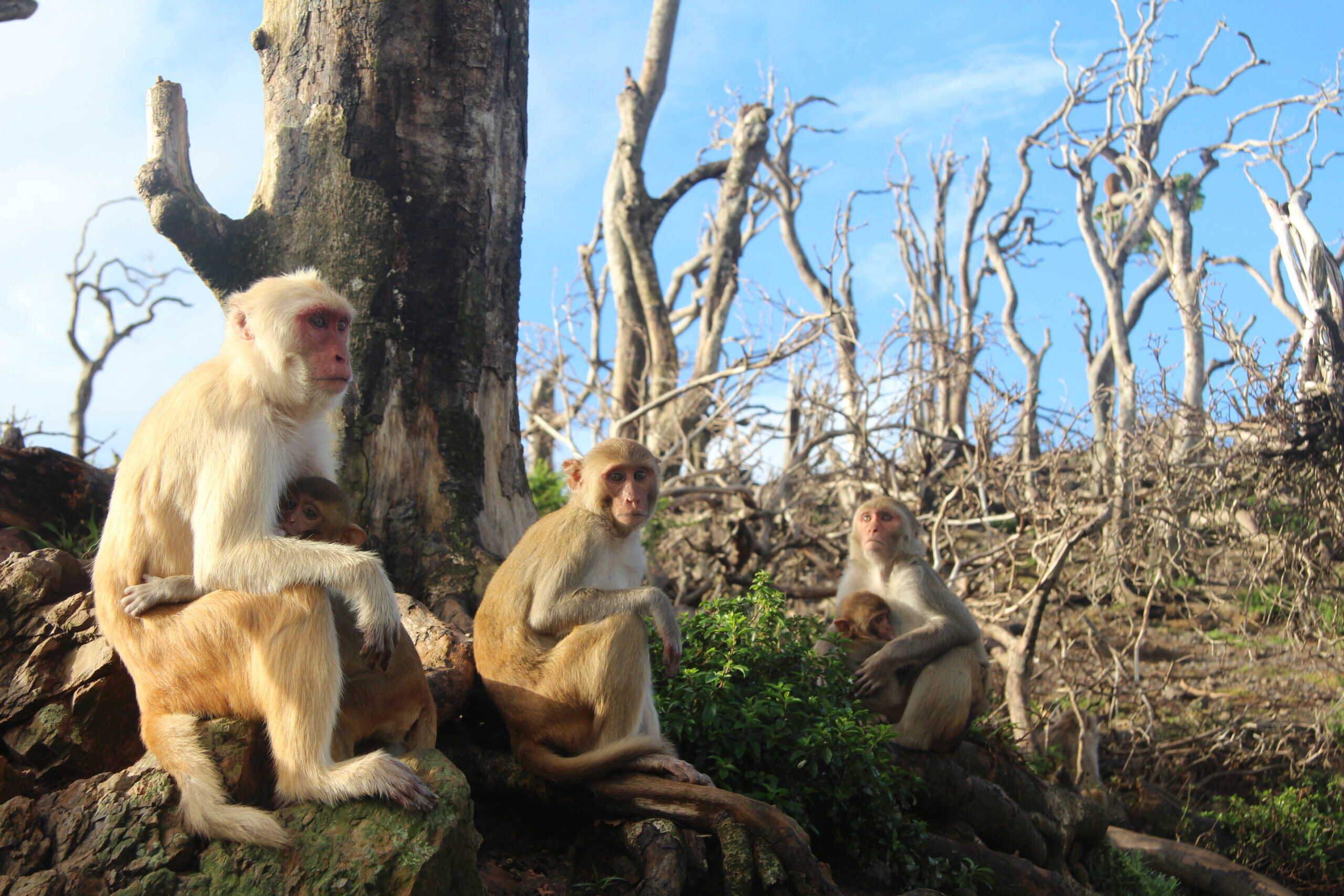
Hurricane Maria Changed ‘Rules or the Game’ in Monkey Society

IMG_9009_LaurenBrent_Copyright-2

In a new study published in Science, Michael Platt, Penn Integrates Knowledge Professor and Faculty Director of the Wharton Neuroscience Initiative, shows how Hurricane Maria reshaped social behavior among rhesus macaques on Puerto Rico’s Cayo Santiago.

Alongside collaborators Professor Lauren Brent, University of Exeter, and Camille Testard, Ph.D. Candidate, University of Pennsylvania, Platt found that in the aftermath of environmental devastation, monkeys became more socially tolerant as a strategy to survive extreme heat and limited shade. The findings offer striking parallels to human resilience, showing how social connection can serve as a vital survival mechanism under climate stress.Read More

To Protect Children Online, Researchers Call for Cross-Disciplinary Collaboration

A child wearing a pink shirt is focused on a smartphone in a dimly lit room, with blurred lights in the background.

A recent perspective in Science calls for stronger collaboration between neuroscience, psychology, and law to create policies that safeguard children online. As digital environments increasingly shape how young people think and behave, the authors stress the urgency of evidence-based regulation that accounts for children’s unique developmental vulnerabilities. With contributions from experts at Penn, the piece emphasizes the need for rapid, translational research to inform policy in step with today’s fast-moving technological landscape.Read More

Penn Study Weighs Instant Gratification vs. More Prosperous Future

A glass sphere encloses swirling metallic cubes with a small set of clock hands at the center. The background transitions from blue to orange, suggesting a blend of technology and time.

Professor Joseph Kable and Ph.D. student Trishala Parthasarathi’s research found that individuals with more vivid imaginations tend to be more impulsive, particularly in choosing immediate smaller rewards over larger future ones. Their study, published in Frontiers in Psychology, suggests that visualization training may actually increase impulsivity, challenging conventional expectations about enhancing patience through visualizing future goals.Read More