

Building Better Business through Brain Science

How Can AI and the Human Brain Work Together?

Wharton’s Elizabeth (Zab) Johnson and Michael Platt join Eric Bradlow, vice dean of Analytics at Wharton, to discuss how AI is being used in neuroscience to better understand the human brain. The conversation covers remarkable research developments in measuring brain activity, replicating speech and mobility, mental health, and more. This interview is part of a special 10-part series called “AI in Focus.”

Our Community

We are a community of faculty, undergraduates, graduate and professional students, and staff interested in connecting brain science and business.

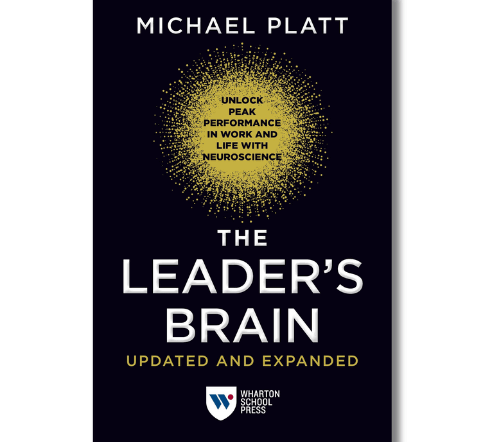
The image is a book cover titled "The Leader's Brain" by Michael Platt, subtitled "Unlock Peak Performance in Work and Life with Neuroscience," published by Wharton School Press.
The Leader’s Brain: Updated and Expanded 
Unlock Peak Performance in Work and Life with Neuroscience

Our brains are more like Swiss army knives than computers, and the component tools can be measured, selected, and sharpened with insights from neuroscience. Doing so beenfites all aspects of business and work and will improve health and wellbeing.  Michael Platt has fully updated and expanded this edition of the Leader’s Brain  to address today’s challenges. With an all-new chapter on AI and new case studies and research insights throughout, the book will be of renewed interest to existing and new readers.

Purchase Your Copy Here

Person typing on a laptop with holographic display of AI and code, representing artificial intelligence technology and programming.

Computer scientist, and Wharton Neuroscience affiliated faculty member, Konrad Kording and economist Ioana Marinescu have developed an interactive model that incorporates assumptions from both their fields to predict how AI will affect wages, jobs, and the overall economy.

Read More

See simulations from the manuscript “Intelligence Saturation” here

Illustration of a person presenting to a small group in business attire, with speech bubbles representing communication.

A new study by the Communication Neuroscience Lab at the Annenberg School for Communication, its director Emily Falk, and colleagues reveals that activity in brain regions associated with reward and social processing can predict the effectiveness of messages.

Read More

Read the Study

An eye composed of binary code, symbolizing digital surveillance or artificial intelligence.

A new study from Wharton faculty, including Wharton afilliated faculty member Marius Guenzel, explores how AI can extract personality traits from facial images – and what that means for your career.

Read More

Read the Study

Two people walking in a hallway, both wearing business attire. One is holding a folder, and they appear to be engaged in conversation.

Imagine a company that not’s hiring just for today but for the future. How Wharton Neuroscience, Korn Ferry Institute and Lazul.ai are uncovering the science behind tomorrow’s leaders.

Read More

A person with long hair wearing a futuristic headband, seated in a theater or auditorium, focused on something ahead.
Why the Future of Ad Testing Might Live Inside Your Head

As an advisory board member of Glassview and cofounder of Cogwear, Michael Platt has created a partnership that uses EEG headsets to capture emotion in real-time, hinting at a future at a future where campaign testing starts with brain data, not surveys.

Read More Here

Platt_Korn Ferry

A new study, led by Vera Ludwig in collaboration with Blaire Berry and Jenny Wey (two MindCORE Summer Fellows), Lana Prieur and Scott Rennie (formerly members of the Platt Lab), and Michael Platt, proves that social connection is crucial for well-being and health and can be enhanced by dyadic meditations. They also created a Nano Tool!

Read More

Read the Study

Nano Tool

Wharton Led / Penn Wide

As a premier research business school, Wharton boasts an outstanding faculty, a thriving MBA program, a strong research PhD training program, and unequaled undergraduate program situated on a cohesive and compact campus in Philadelphia, a major east coast city that is riding a new wave of financial and cultural investment tied to the new urbanism movement. These assets are complemented by the University of Pennsylvania and all of its constituent Schools, including Arts & Sciences and the Perelman School of Medicine.

Science

SCIENCE

Driving new research discoveries and novel applications.

Education

EDUCATION

Developing future leaders at the nexus of business and brain science.

Community

COMMUNITY

Connecting Wharton, Penn, alumni, business leaders, scientists, policy makers, and the public.

Partnership

PARTNERSHIPS

Bringing experts in business and academia together.

Programs

PROGRAMS

Providing opportunities to learn, engage, and connect.

STUDENTS

Learning by Doing

Interested?  Get involved in research and take courses with world leaders and experts.

Subscribe to Our Mailing List

Come Visit Us!

Get your free Wharton Neuroscience Initiative pen*

Office Hours: Monday to Friday, 9 to 4:30 pm

106 Steinberg-Dietrich Hall
3620 Locust Walk
Philadelphia, PA 19104
Ph. 215-898-7766

*while supplies last

106 Steinberg-Dietrich Hall
3620 Locust Walk
Philadelphia, PA 19104
Ph. 215.898.7766
Wharton Neuroscience Initiative Logo